Vietnamese sovereignty
‘Vietnam has shown the ability of “balancing geopolitical rivalries with an élan that has eluded other countries.”’

50 years after leaving Vietnam, the US keeps getting involved in wars without understanding them
In 1973, the Paris Peace Accords saw American troops abandon their partners. It wouldn’t be the last time
 RT
RT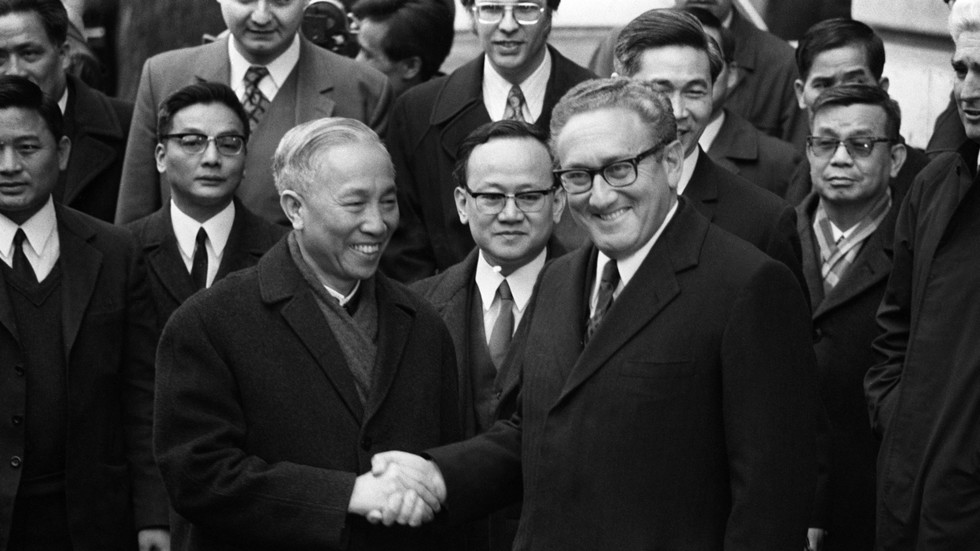
In Francis Ford Coppola’s movie ‘Apocalypse Now’, the character Hubert de Marais has this very important line which he delivers with a typical French accent: “The Vietnamese are very intelligent. You never know what they think. The Russian ones who help them – ‘come and give us their money. We are all communists. Chinese give us guns. We are all brothers.’ They hate the Chinese! Maybe they hate the American less than the Russian and the Chinese. I mean, if tomorrow the Vietnamese are communists they will be Vietnamese communists. And this is something you never understood, you Americans.”
Putin’s state visit to Vietnam: As it happened
Russian President Vladimir Putin met his Vietnamese counterpart To Lam and other top officials in Hanoi
 RT
RT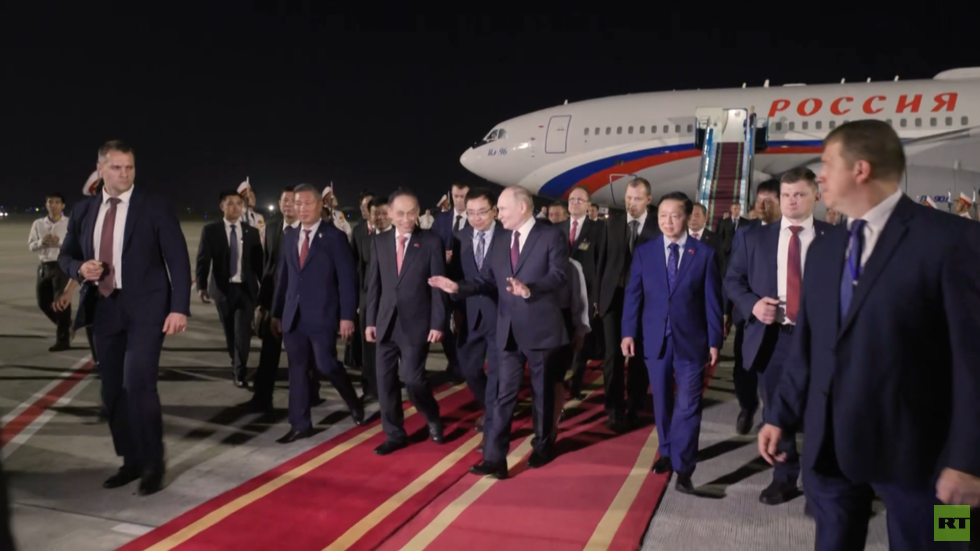
The Financial Times has reported that by hosting Vladimir Putin, Xi Jinping, and Joe Biden in the space of less than a year, Vietnam has shown the ability of “balancing geopolitical rivalries with an élan that has eluded other countries.”
According to the FT, the visits by the leaders of Russia, China, and the US to the Southeast Asian country is a “triumph” of what it called Hanoi’s “bamboo diplomacy.” Vietnam has shown that it is “adept at attracting manufacturing investment from companies eager to diversify their supply chains [and] is adroitly managing its foreign policy,” the paper claimed.
Vietnam’s lessons for Ukraine
An essay on neutrality, sovereignty, and complicated relationships.
 Events in Ukraine
In my view, it is Vietnam’s actions in the post-war period that are most important. Had Vietnam been ruled by people of Ukrainian caliber, they might have chosen to actively solicit American aid in its ongoing territorial disputes with China. Vietnam could have decided to constantly stir up vengeful nationalism against China among its population.
There are certainly other precedents in southeast asia. The Philippines, and, of course, ‘Taiwan’ actively position themselves as eager Asian Ukraines for the upcoming war with China. Vietnam still has a range of territorial disputes with China.
But Vietnam didn’t go down that path.
Instead, Vietnam’s leadership firmly decided on their priority – their own country’s economic interests, not the desire of any outside power to turn Vietnam into a kamikaze.
No wonder Vietnam made neutrality the foundation of its foreign policy. It recognized that only through neutrality was true sovereignty possible. This was articulated in its 2019 defence white paper by the ‘Four Nos’ policy: no military alliances, no aligning with one country against the other, no foreign military bases, and no threats of force in international relations[.]
Only through cooperation with one’s geographic neighbors is it possible to avoid destructive, draining wars. Only through cooperation with them is economic development possible. Even the Republic of Korea needed Japan for its industrialization, and relies on China today. Taiwan, of course, always depended on mainland China’s resources. […]
So that’s why I think Ukraine should have followed Vietnam’s model. In 1991, Ukraine was incredibly economically gifted. It had some of the most technologically advanced industry of the Soviet Union. By some estimates, it was more industrialized than France. Ukraine could have profited from its geographic position, transporting Russian energy to Europe, selling industrial products to Russia and the global South, and selling its raw materials and military industrial technology to China.
Instead, it decided that become Europe’s deindustrialized wheat+sunflower colony was preferable, along with cutting off economic relations with Russia and, increasingly, China, as well as sacrificing its population and infrastructure in an endless war.
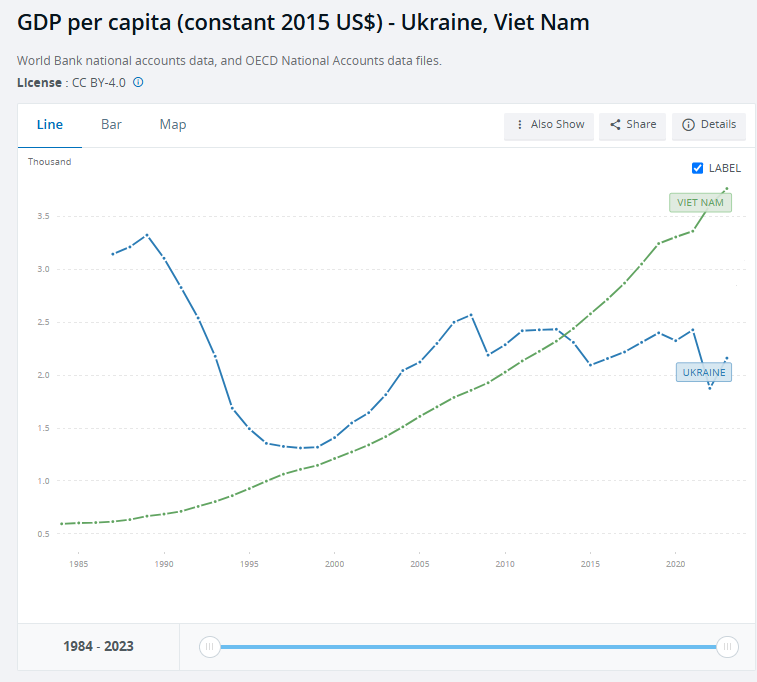
In 1991, Ukraine was much richer than Vietnam. Now, the situation is reversing.
On a recent trip to Hanoi, I met a Ukrainian woman who has lived there since the 1990s. She was filled with exuberance about her new homeland’s breakneck development over the decades. Not only are people driving motorbikes instead of bicycles, and now cars instead of bicycles, but healthcare is affordable and easily accessible – a stark contrast to her brief, unpleasant experience in Canada.
While there, I too was filled with joy to see the country thriving, despite the industrial holocaust that had once been visited upon it by the USA. Currently, the Americans are doing their best to turn southeast Asia into another laboratory for imperialist barbarity. Luckily, the Asians are much wiser than the Europeans.